
From Digital Blueprint to Starbound Terror
Choosing the perfect 3D printed ship for Mothership and Alien
So what’s this all about?
The moment I was invited to an in-person game of Mothership, the hyperdrive in my head started spinning up and I started wondering if there was a ship I could 3D print for the session. I already had the great fortune of discovering the sculpting team 2nd Dynasty, which is led by a sculptor named Ben Mowbray, a bespectacled, ponytailed fellow who speaks with a distinctly Australian accent but who I think may originally be from a Scandinavian country due to his impeccable pronunciation of the Norse ship names that he occasionally employs. Anyway, I discovered them a few years ago and they’ve been the source for the single best and most comprehensive starships designed for 28mm scale (or higher) scifi RPG play. That’s a very specific genre of product so I’m glad that they’ve found enough of an audience to keep themselves in business.
My first question was: which ship should I print? Actually, the question before that was: does the GM and players for this upcoming game even WANT to use a 3D-printed ship? I floated that question to the group on the game’s Discord and never got a solid answer. If you’ve ever met a 3D printing enthusiast, you’d know that they never let a trivial thing like “need” or “actual use” get in the way of printing a multi-spool, multi-week print project. So that left the question of which ship would I be printing.
The Shipyards of 2nd Dynasty
As mentioned, the breadth and detail of Ben’s starship designs is second to none. He has largely been inspired by Traveller designs, which definitely tend more towards the pulpy 1970s aesthetics of blocky, conspicuously un-aerodynamic geometry. But he has also dabbled in the extremely modern and (probably) more realistic designs featured in The Expanse. It was one of these Expanse-inspired ships that first captured my imagination and had me running my printer day and night for a week.
That first ship was the Sleipnir, named after the god Odin’s own horse, which incidentally had eight legs and was thus very fast. The starship Sleipnir is essentially an 11-story scifi tower, each floor detailed with different starship functionality like cargo hold, bridge, mess hall, med bay, etc. I think it took about $120 in filament to print and at the time of writing I have yet to get it to a game table, but it has served well as a conversation piece and bit of display art (when I can find occasion and space to actually display it).
But 2nd Dynasty’s ship offering go way, way beyond this ultra-complex tower ship. I want to walk you through each of the offerings that I went through so that you can follow with me on this journey of finding the right ship for Mothership.
So one thing I’m going to do here is spare you the technical specs of these ships, which are usually based on the ship rules from the Traveller RPG. Those specs are simply irrelevant to this discussion. What I’m wanting to look at with each ship is its interior space for the most part: what kind of character, environment and enemy interactions can be had inside and outside of the ship.
The Erebus
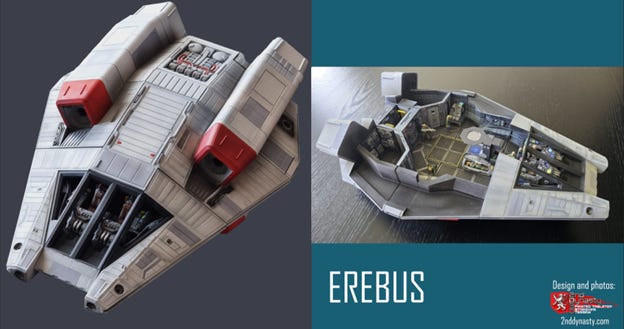
Size: This is a cool ship on the exterior. It’s got that Traveller vibe, which I am generally not in love with, but it’s got enough dynamic lines to make it intriguing. Floorspace-wise, this is one of the smallest ships available.
Functionality: You just can’t do much with the interior. Although there could be some close-quarter encounters, the fight would be relatively limited. And there are only about five zones to explore. In terms of time at the table, this just wouldn’t occupy much.
Vibe: This is a bonus ship, I think. One that you throw at players at the tail end of a mission in an escape scenario or something. Think of the end of Alien (1979) when Ripley escapes on the Nostromo shuttle Narcissus. The safety-turned-claustrophobic nightmare is just classic.
The Typhon
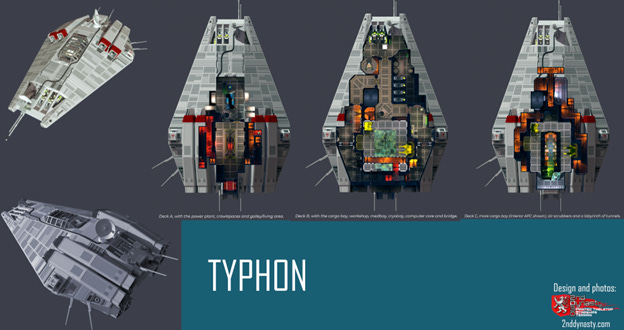
Size: This one is way bigger, with three playable decks. That means way more filament and print time, of course, but we’re not concerned about that at all, are we?
Functionality: The three decks allow a lot more flexibility in terms of where characters can go, where mechanical problems can occur, where MacGuffins can be hidden, and of course where enemies can hide. And with most multideck ships that 2nd Dynasty has designed, each deck is a separate and discreet item that can be lifted and displayed independently on the table, so you can view all three decks at the same time.
Vibe: As spacious and multi-decked as this ship is, I don’t really like how “buried” the bottom deck is, all hemmed in by the walls. In actual play, this makes things inside of that virtual pit very hard to see and hard to manuever. That same problem also plagues the top deck to a smaller degree. You really have to stand up and lean in to see anything on those more closed-in decks.
The Sausage Ships
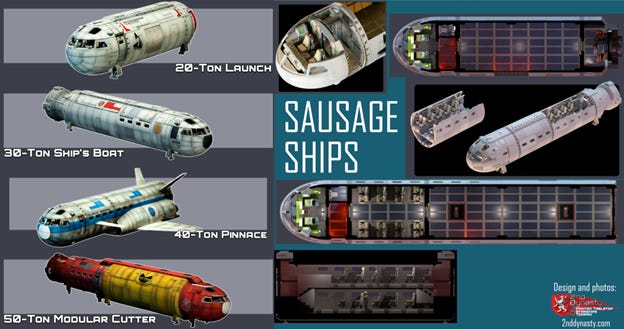
Size: I’m lumping these four into one entry because they’re really just one modular ship that you can build at different sizes. I think at first glance, the smallest iteration might seem too small, but it totally depends on how you structure the interior.
Functionality: Despite the relatively goofy shape of these ships, a feature that can be remedied with modular wings and wing-like attachments, this ship system is intriguing in the extreme to me. If you look at the screenshots above, most configurations suggest that you put in rows of seating, like a modern day commercial airliner, and maybe reserve some space for a cargo hold or something. This has the potential for all kinds of fun scenarios involving NPC passengers on a flight who turn out to be spies, infected, terrorists, etc. The hybrid approach of some passenger seating plus a cargo area allows for the most dynamic play possibilities.
Vibe: This ship system is so good that I can’t write it off. It’s basically on my list of things to print sometime down the line. But as you read on, you’ll discover that I ultimately settled for another ship design for my current mission.
Free Trader Beowulf
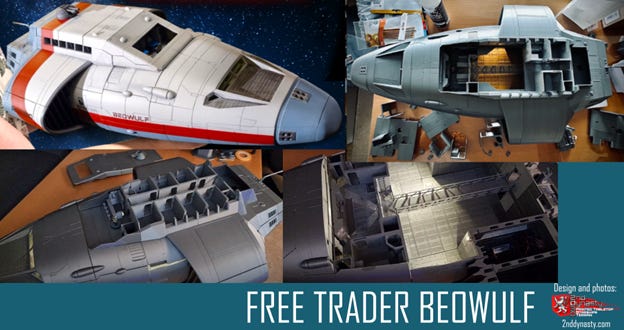
Size: This is a bit of a monster. There are essentially two decks, a top and a bottom. And a whole bunch of curved exterior hull that is an artifact of the original design rather than anything the modelers intended.
Functionality: The screenshot above that shows the different crew compartments is an absolutely perfect setup for survival scifi horror. You want to give players tons of rooms to explore and tight spaces to be ambushed by some face-sucking monster or places for them to hide from said face-sucking… maybe it’s not a monster, okay? Maybe it’s just misunderstood. The very large cargo hold below is also great for different play possibilities but this is a particularly “deep” room that is somewhat difficult to see at the table, and thus somewhat difficult to maneuver miniatures and terrain pieces. The curvature of the hull also creates lots of dead space in the model that is not playable at all.
Vibe: If you recognize this ship by name or by sight, then you’re officially a Traveller nerd. This ship was featured as the very name of the box for the first edition of Traveller in 1977, along with the phrase “This is Free Trader Beowulf, calling anyone… Mayday, Mayday…” and the game’s publishers have enshrined it as a sort of mascot for the game itself. If you’re a true Traveller fan, then this ship is practically a must-print, just for the purposes of display if anything. Unfortunately, I’m not personally all that into Traveller, nor am I into this quintessentially 1970s ship design. Moving on…
Shuttle Alpha (Mk III)
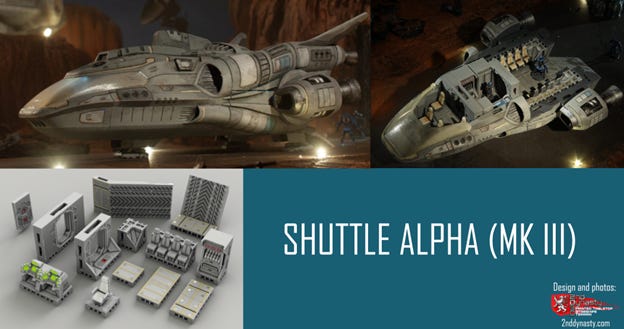
Size: The name says it all. This is a shuttle-class vessel, meant to ferry crew between larger ships and down to planet surfaces or to derelict space stations full of murderous alien entities. It’s got a four-seater bridge, with intermediate hold area, and larger cargo space in the back that opens quite widely to a down ramp.
Functionality: Again, you’re not going to be able to squeeze all that much play out of a ship this size. It’s definitely a nice one to have for single-encounter situations (see Ripley on the Narcissus at the end of Alien). But you can’t do too much over the course of a session with a ship this size.
Vibe: The exterior design is very reminiscent of the Marine dropship in Aliens (1986), and this sort of slick 1980s design is definitely more my speed. Unfortunately the exterior design doesn’t really contribute to the playability of the interior. It just looks cool on the outside, for what that’s worth.
The Type S
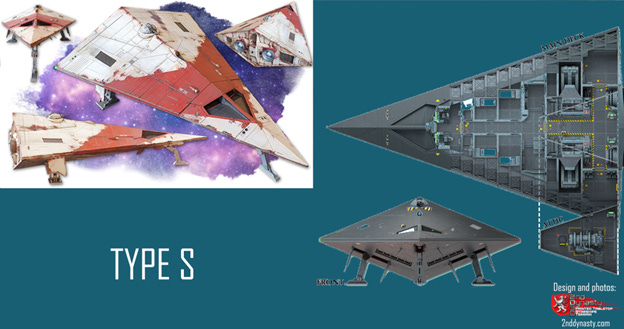
Size: This is a large ship. I know because I actually printed it. Some years ago, 2nd Dynasty actually approached me about some free promotion on my YouTube channel and they sent me this model. Long story short, it’s a very large ship, with essentially one main deck.
Functionality: I can’t really fault this ship’s design in terms of play functionality. You get a lot of different rooms, which is good for survival horror, and the space is just generally very good for customization. Some of that interior space is eaten up by retractable landing gears, which is not something that almost any other 2nd Dynasty design has, and that retractability is purely for exterior display purposes.
Vibe: So, confession time: I don’t like this ship. I don’t like its exterior lines, I don’t like the blocky walls along the inside of the outer edges. I don’t like the finnicky retractable landing gears (something I only know about from experience printing it). This ship is based squarely on a ship from Traveller, if you hadn’t guessed already, and it feels more like fan service than something that is designed for people who like to print durable, functional things that work at the table for RPGs. But yeah, if you’re a super fan of Traveller, this ship is a gift from the heavens, and Ben’s name has been praised heavily and often by those fans for what he was able to accomplish here.
Beta Centauri/Scout Ship Beta
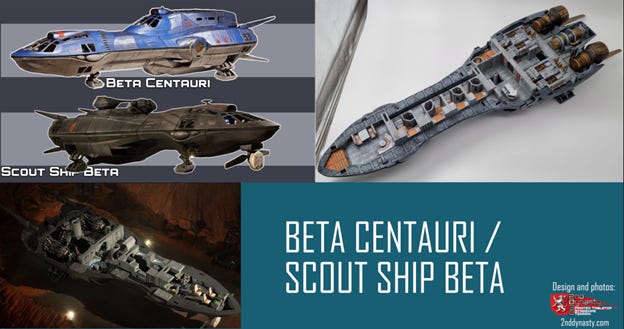
Size: This is a very long and narrow beast. In terms of rolls of filament required to get this thing printed out, it definitely feels like a three-roll job.
Functionality: I want you to take a closer look at the interior shot above on the right. Check out how wide the outer hull is when looking at the interior from the top down. This is very problematic because this is not really playable space, but it is space occupied by plastic (and print time and table space). In other words, there is a lot of wasted space here. The same goes for the relatively gargantuan engines in the back of the ship.
Vibe: The exterior of this vessel is undeniably super cool. The sleek form factor is great. But once you pop open the top, it turns out that the ship is a case of form over function. Here’s the thing: once you start down this dark path of a 3D printing addiction, storage and display space in your living quarters becomes scarce and precious resource. So the ideal with one of these big honking spaceships is that it can do double duty whenever possible: 1) look cool on the outside for display purposes, but also 2) have a useful, spacious, playable interior. This particular design does not check both boxes.
Pathfinder/Chimera/Pegasus/Cerberus/Odyssey
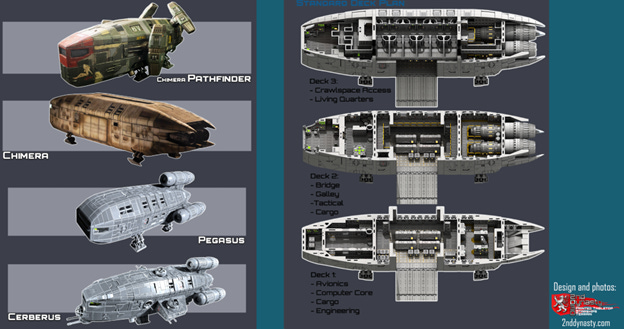
Size: I am sort of doing Ben a disservice by lumping these four ships together. There MIGHT be some fundamental differences between them, but they’re not enough to detract from the unavoidable fact that these are HUGE. Three decks each, and almost three feet long when printed out.
Functionality: The functionality of these ships is maximal. There are so many rooms across the decks that can be furnished with the hundreds of different little scifi bits and bobs that 2nd Dynasty has included (as well as any free-standing bits or bots that you might find from other designers and scaled down to the right size). You could run entire sessions out of one of these ships. Well, maybe one or two entire sessions. I wouldn’t want to rely on the ship TOO much, but it really does serve as a small dungeon in terms of exploration.
Vibe: I can’t believe I’m saying this, but I think this form factor might be too big for my tastes. Gaminggeek on YouTube printed up one variant, the Cerberus, and it was only after seeing his interior that I realized this might be a bit too much for me. The transportation and storage of this ship might pose a challenge. Also, I find the exterior design to be a bit bland. Almost… TRAVELLER-like if you please.
Sleipnir Variants
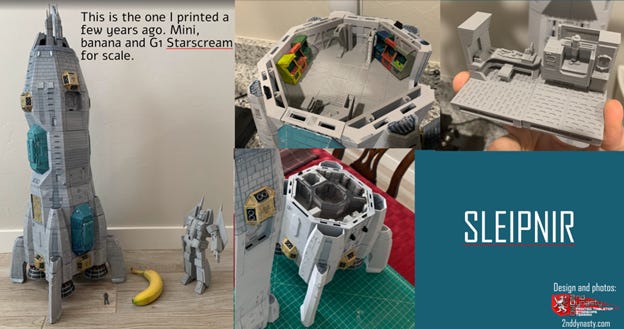
Size: This is the one I printed a few years back, a true monster requiring countless rolls of filament and weeks of printing. It splits out into 11 different floors or levels, each of which can be displayed simultaneously since they are separate room assemblies that each lay flat on a table.
Functionality: I still haven’t gotten this into a game. But I consider it to be the ultimate wizard’s tower, but the scifi edition. Each floor can act as a level in either a descent or ascent. The top floor is the command deck, so you could have players start outside the ship and their goal is to make their way up each floor with the objective of gaining control of the ship and escaping the planet/asteroid/station/forehead of angry alien. There are actually many ways to use this ship.
Vibe: The rooms are a little bit small and claustrophobic, if I’m being honest. I think the overall design is great, and the exterior is cool, especially all the new variants. I mean, check out these variants:
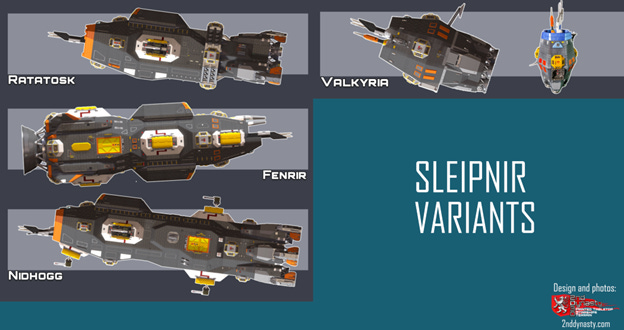
This ship is truly a living design ecosystem that can be reconfigured both on the exterior and the interior literally millions of different ways. It’s kind of the ultimate vertical scifi playset for adults. But that being said, it’s a tad big, and I don’t want to bust this thing out on a first session of Mothership with folks I haven’t played with before. I don’t want the ship to get in people’s faces and take the spotlight.
Haena

Size: I could almost have lumped this one in with the Sleipnir variants, but it’s just different enough that I have to give it a separate entry. Despite the squat, compact-looking appearance of this ship, it’s actually pretty girthy and tall! Check out the number of floors it has.
Functionality: This ship has all the cool potential that the Sleipnir has, but with roughly half the number of playable floors. Which is fine. Like I mentioned, I think the Sleipnir-class ships are wee bit too big in some cases. But the Haena, look at her! Seven playable decks, and an explosion of interesting external features that you can make players have to don an EVA suit and fix at risk of life and limb. It’s perfect!
Vibe: I think for display purposes, I would print this model as-is. But all that busy business at the top of the ship is extremely delicate whether printed in plastic or resin. It just doesn’t look like it would travel well. I would consider reducing some of that busy-ness down a bit if I were hauling this thing around. But honestly, I love the ugly, highly utilitarian look of this ship. If painted well, it could be a striking display piece. Because remember, it’s actually kinda big! This ship, in fact, goes on my short list of Things to Print in the Near Future. It’s a winner. But not THE winner. That honor goes to…
Transport Ship Delta
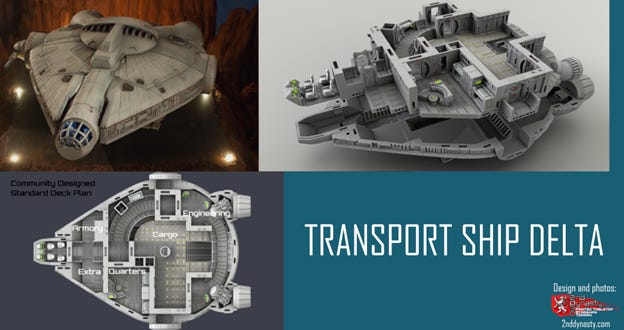
Size: This is a medium sized ship comprised of a single deck. The interior is completely modular, like all these ships, but comes with about five or six distinct zones. There is a lot of dead space below and above the deck itself, but it’s not really that visible and thus doesn’t really bother me.
Functionality: This shape and size is in the Goldilocks Zone that I’ve been looking for. It’s big enough that there can be a number of rooms to mess around with and keep players intrigued. It’s wide enough that players aren’t bottlenecked into going fore and aft or up and down the inside of the ship. And it doesn’t have large decoration-only components that eat up a bunch of precious play space.
Vibe: As you may have immediately noticed, this ship is inspired almost entirely by the YT-1300 Corellian light freighter originally designed by Joe Johnston. This particular model was originally made in 2019 but Ben and his team revisited it in 2024 and released some very eye-pleasing and very Star Wars-y options for the original. I have decided that I will mostly be using the options from the 2024 upgrade pack.
TLDR
The Transport Ship Delta is the winner. It’s the one I’m going to print, furnish, paint and design encounters around for either Mothership or Alien RPG. The hope is that I’ll also be able to loan it to the GM running Mothership in a game in which I’m a player. He’s a bit of a genius GM so I’m sure he could take one look at the interior and come up with all kinds of fun ideas.
What’s next?
The next step is to start printing. I will detail that entire journey in the next couple of installments in this series. But for now, I’ll leave you with this cockpit, printed in resin for maximum detail:
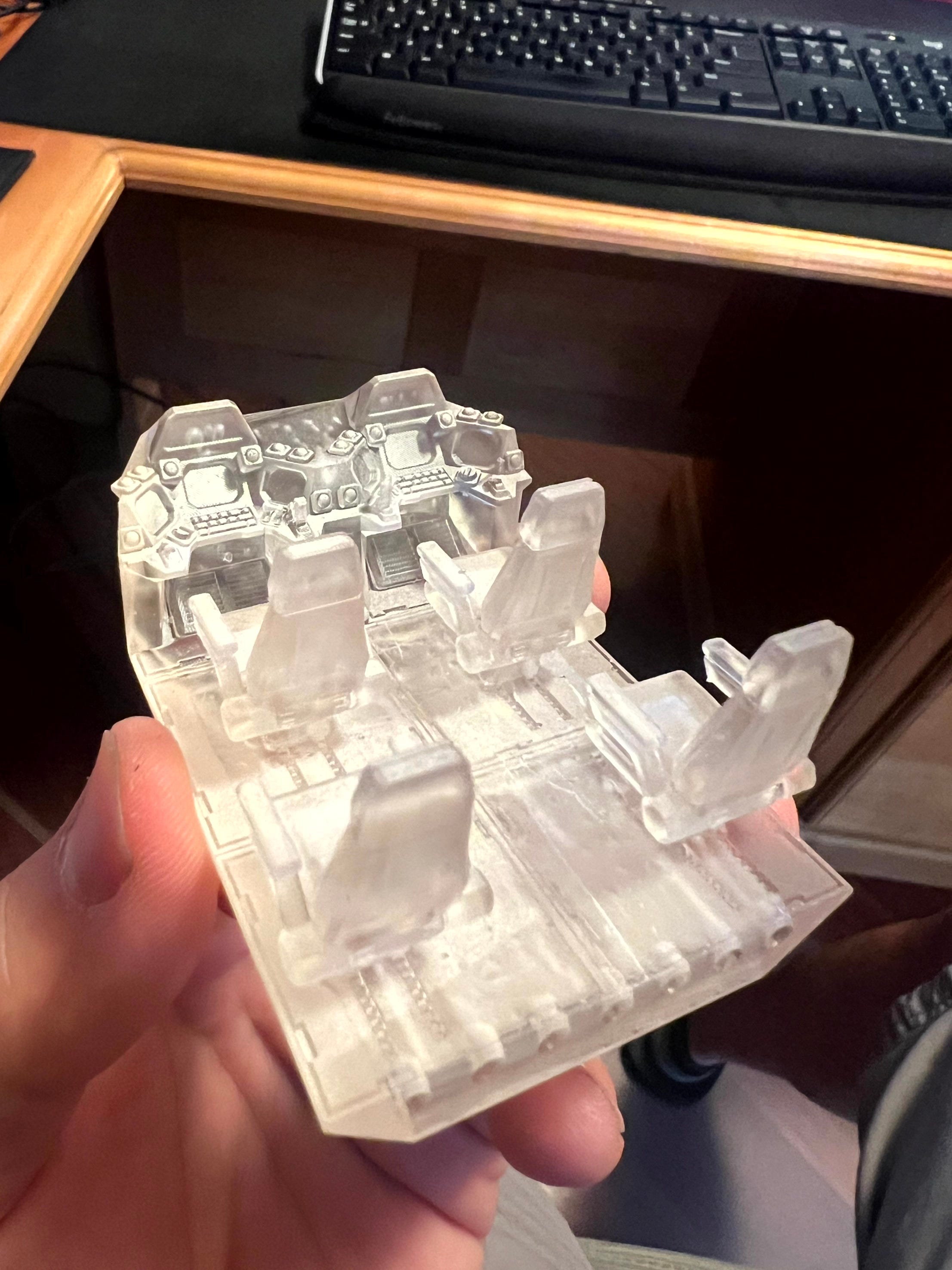
Leave your comments about this journey down below, and please make sure to ask me any questions you have about this whole process. I’d also love to hear suggestions about what you’d like to be included in this ongoing series.
Ship History Generator
Here’s a series of tables that might help with coming up with the sordid history of a vessel before the player-character crew even steps foot on it. These tables don’t all necessarily jibe with one another. You can just peruse and use them as needed for inspiration. And feel free to use and alter these tables however you wish in your own publications. (Creative Commons BY - Dave Thaumavore).
Previous Crew Fate (d10)
Vanished during routine EVA maintenance - suits found empty, tethered to the hull
Killed by escaped quarantine specimen from the medical bay
Murdered each other in escalating paranoia over perceived corporate spy
Evacuated in lifepods after catastrophic system failure - pods never found
Discovered dead at their posts from unknown airborne pathogen
Went insane from prolonged exposure to alien artifact in cargo hold
Executed by corporate security team to contain information breach
Transformed into something no longer recognizably human
Still aboard ship in some form - now hostile to new arrivals
Sold into slavery by captain to pay off massive corporate debts
Last Mission Type (d10)
Routine cargo delivery to outer rim mining colony
Scientific specimen collection from uncharted world
Corporate executive transport to sensitive negotiations
Emergency supply run to distressed research station
Classified military equipment transport between facilities
Archaeological survey of ancient alien ruins
Prisoner transfer from corporate detention facility
Salvage operation on competitor's "lost" vessel
Deep space reconnaissance beyond charted systems
Cover operation disguised as mundane freight hauling
Time Since Incident (d10)
3-7 days - bodies still intact, systems recently failed
2-4 weeks - decomposition evident, automated systems struggling
2-6 months - ship dark and cold, emergency power only
1-2 years - vegetation growing in hydroponics, extensive coolant leaks
3-5 years - significant structural decay, jury-rigged repairs visible
5-10 years - ship partially salvaged by previous visitors
10-20 years - corporate records list vessel as "total loss"
20-50 years - ship design noticeably outdated, vintage equipment
50-100 years - archaeological significance, pre-war technology
100+ years - ancient by corporate standards, possibly pre-contact
Primary Incident Cause (d10)
Alien contamination brought aboard in cargo containers
Sabotage by corporate rival's embedded operative
Mutiny sparked by discovery of ship's true mission
Catastrophic engine malfunction during FTL jump
First contact scenario gone horribly wrong
Experimental corporate technology malfunction
Crew member's gradual possession by alien intelligence
Pirates boarded but found something worse than expected
Navigation error stranded ship in interdimensional space
Corporate "cleanup" operation to eliminate inconvenient witnesses
Corporate Cover-Up Level (d10)
No cover-up - company genuinely doesn't know what happened
Minimal - incident filed as "equipment malfunction, crew error"
Standard - official logs altered, families paid compensation
Active - corporate security monitoring salvage frequencies
Aggressive - bounty placed on ship's black box recorder
Ruthless - previous salvage teams eliminated to maintain secrecy
Systematic - entire sector declared off-limits for "navigation hazards"
Desperate - company executives personally overseeing containment
Paranoid - cleanup crews don't know what they're really cleaning up
Catastrophic - corporate board considers scorched earth nuclear option
Crew Personal Effects Left Behind (d100)
1-2. Child's drawing tucked into captain's personal locker
3-4. Engagement ring in jewelry box, wedding planned for shore leave
5-6. Handwritten letters never sent to family back on Earth
7-8. Illegal stimulants hidden in engineering maintenance kit
9-10. Encrypted data pad containing evidence of corporate crimes
11-12. Religious shrine assembled from spare parts and personal items
13-14. Gambling debts documented in crew member's personal notes
15-16. Photographs of unidentified alien structures from previous missions
17-18. Suicide note dated three days before the incident
19-20. Corporate loyalty oath signed in what appears to be blood
21-22. Personal diary documenting strange dreams and visions
23-24. Home-brewed alcohol hidden in maintenance compartments
25-26. Half-finished wood carving of Earth animals from memory
27-28. Wedding dress preserved in vacuum storage for return home
29-30. Collection of pressed flowers from various alien worlds
31-32. Crude map sketched on napkin showing hidden corporate facilities
33-34. Meditation crystals arranged around crew quarters
35-36. Love poetry written in margin of technical manuals
37-38. Contraband xenobiological specimens in personal freezer
39-40. Family photograph with faces deliberately scratched out
41-42. Personal weapons cache behind false wall panel
43-44. Handmade musical instrument crafted from ship components
45-46. Collection of antique Earth coins worth small fortune
47-48. Detailed sketches of alien hieroglyphs in personal notebook
49-50. Emergency rations hoarded beyond regulation limits
51-52. Personal communication device modified for illegal frequencies
53-54. Collection of vintage Earth movies on data chips
55-56. Handwritten will leaving everything to crew members
57-58. Personal hygiene items arranged in obsessive-compulsive patterns
59-60. Stolen corporate identification badges from multiple companies
61-62. Personal garden grown in hydroponics without authorization
63-64. Collection of alien artifacts hidden in personal effects
65-66. Medication for undisclosed psychological condition
67-68. Personal journal written entirely in coded language
69-70. Collection of teeth from various alien species
71-72. Personal robot companion in standby mode
73-74. Handwritten technical specifications for illegal ship modifications
75-76. Personal survival kit prepared for specific planetary environment
77-78. Collection of corporate executives' personal information
79-80. Personal laboratory equipment for unauthorized experiments
81-82. Handmade doll constructed from deceased crew member's clothing
83-84. Personal communication logs with known terrorist organizations
85-86. Collection of rare minerals worth significant black market value
87-88. Personal backup of ship's computer core hidden in quarters
89-90. Handwritten confession to war crimes committed on previous mission
91-92. Personal shrine dedicated to alien deity or philosophy
93-94. Collection of human organs preserved in medical containers
95-96. Personal escape pod hidden in cargo bay without corporate knowledge
97-98. Handwritten contract selling crew member's soul to unknown entity
99-100. Personal time capsule intended for burial on Earth upon retirement
From a ship standpoint, the Type S scout remains my favorite "iconic" Traveller ship, with the Chatl Class Zhodani Leader Scout (hell all the Zhodani ships from https://waynesbooks.games/2021/04/28/traveller-adventure-class-ships-vol-1-2-1982-deckplans-galore/) a close second. FASA's Renegade Legion had some awesome ship designs (sans any deckplans) too.
I am very keen to hear how players respond to these. I came across the 2nddynasty site a while back and fell in love with their "Expanse" style builds, which fit with my sci-fi game world. However when running my sci-fi game (not mothership or alien) my players get caught up with "deciphering the detail" even when explicitly told that it is set dressing. Maybe both mothership and alien are slower paced than my custom game and are better suited to these gorgeous set-pieces. As said, very keen to hear how they go.