Breaking the Hack-and-Slash Habit: How to Build Depth Without Killing the Borg Pace
Alexander Jatscha-Zelt on moving beyond linear dungeon crawls to create the biggest Pirate Borg adventure yet
Back Ravaged by Storms on Kickstarter here.
Origin Story & Partnership
Hey Alexander! Can you introduce yourself and tell us about your connection to tabletop RPGs?
Hi Dave and thanks for having me! So, my name is Alexander Jatscha-Zelt, I’m living with my wonderful wife and two children in the very Southwest of Germany, close to France and Switzerland. Tabletop RPGs have been a passion since I was a teenager of 14 years (37 now), but after many years on and off, I really got deeply involved once again during the pandemic. I’m one of the founders and the owner of indie studio Golem Productions as well as the blog OSR Rocks!
To me, TTRPGs are a form of art rather than “just” a game. But they are also very sophisticated games which allow for fantastic experiences, creative problem-solving, and lots of fun. Human brains are wired to learn through storytelling, as supported by neuroscience research and evolutionary theory. I suppose that’s why they can feel so intense. Also, I’m a storyteller by trade and - correspondingly - the forever GM of most groups I’m playing with.
What is Ravaged by Storms?
Ravaged by Storms is our 72-page mythic sandbox adventure module designed for Pirate Borg currently crowdfunding on Kickstarter — rules-light, art-heavy, and fiercely OSR. It will be published as an offset-printed hardcover book and actually is going to be the largest Pirate Borg adventure yet (first or third party) - until Luke Stratton or Zac Goins throw something larger at us, that is. It is built for multi-session campaigns, while many of the nine fleshed out locations drop cleanly into one-shots, if so desired.
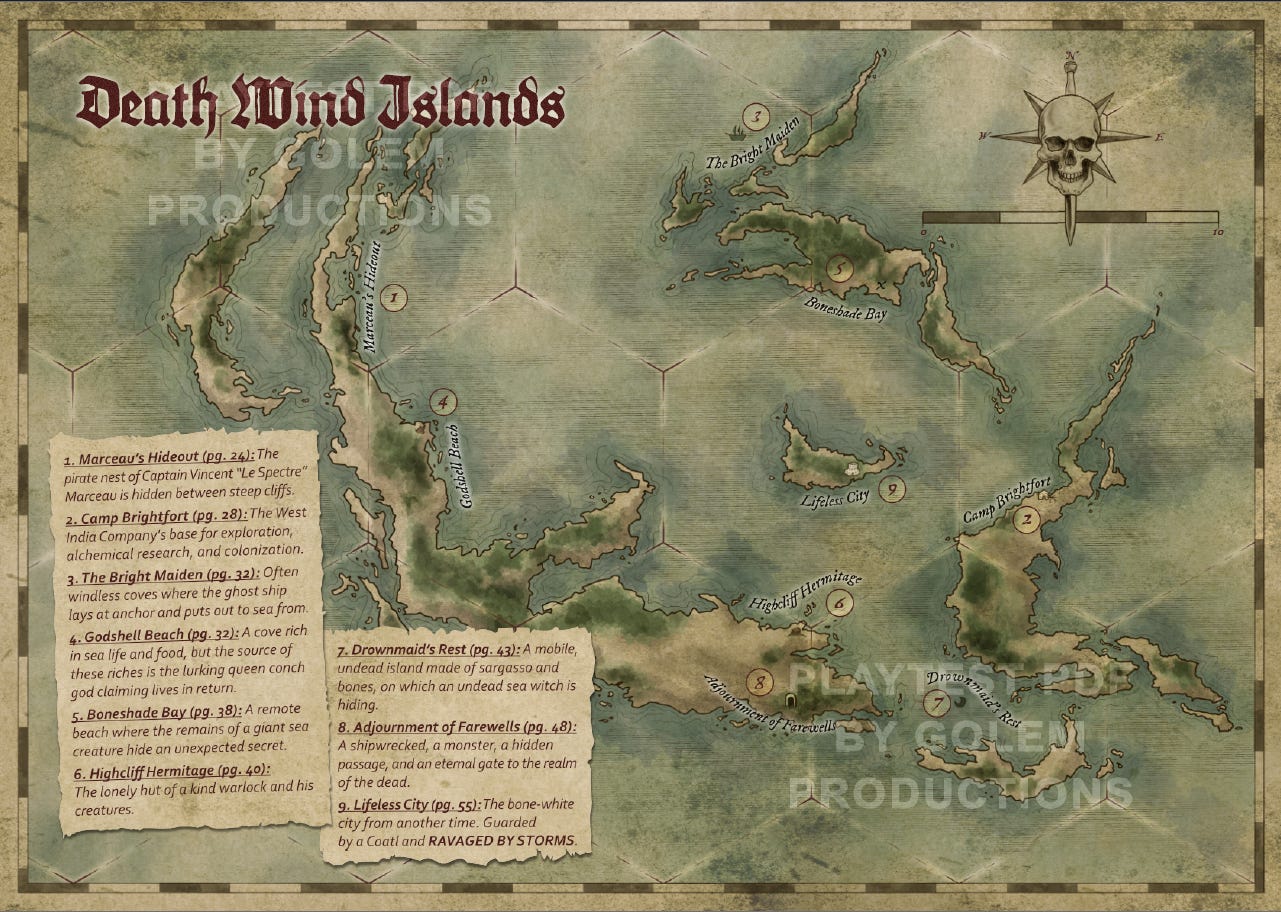
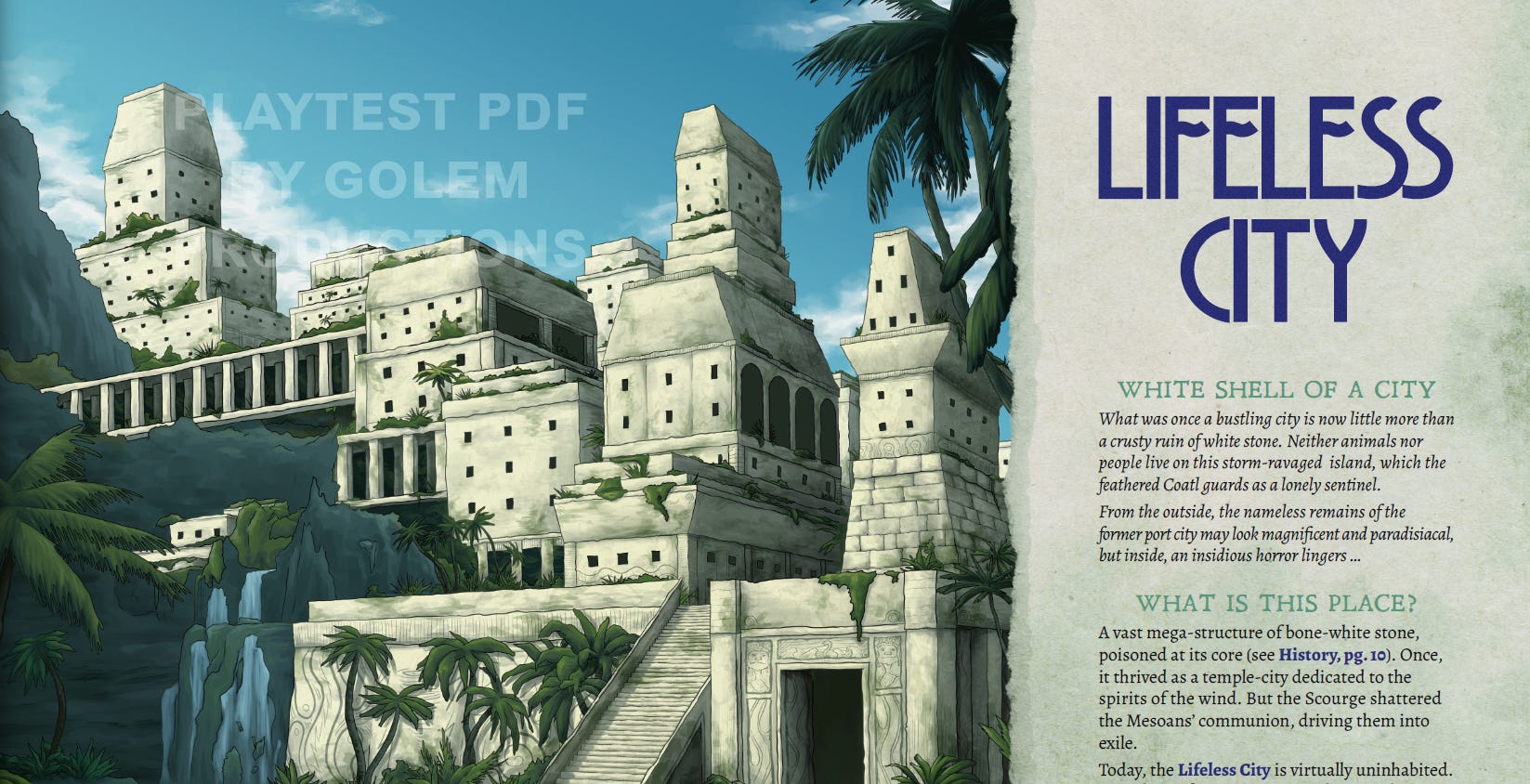
At the center: a Feathered Serpent (Coatl) that dynamically moves through the world as your table plays. Around it: three rival factions, procedures for travel and faction activities, and a Lifeless City you can only reach if you find a way to pass through the storm — or break it.
The adventure is fueled by the competitive hunt for a thief who dared to steal from the Coatl. That said, there is of course no prescribed plot. This is OSR, after all. We’re offering an introductory event that triggers the Coatl and factions into action, but to which players can react however they want, or not at all. After that it’s a sandbox, but people are not going to wait for the players to explore it all. They are going to act if the PCs don’t. And then it’s up to you and your table to play that out.
As a writer-designer duo with your sister Sabrina Jatscha, I'm reminded of the sibling partnership between Pirate Borg creator Luke Stratton and his brother Tyler "Quartermaster" Stratton. What are the pros and cons of collaborating with a sibling in your experience?
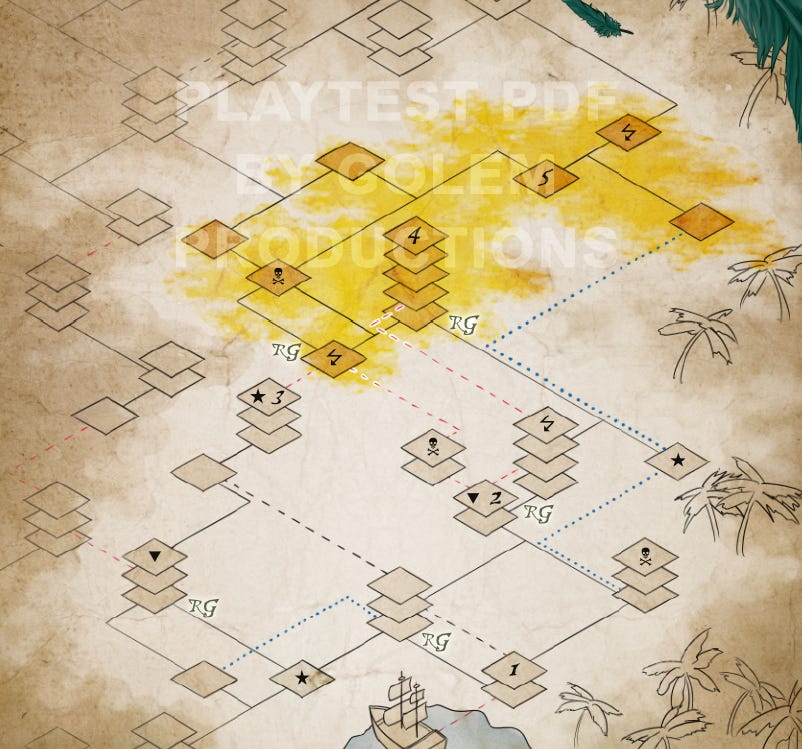
Haha, yeah, that is a coincidence. It kinda just happened. We complement each other perfectly. Sabrina is our art director and also generally works as a graphic designer. She has developed the visual identity of all our publications from maps and illustrations to layout and typography. She created our launch trailer, but also shapes the entire Golem Productions brand across every channel and format. On the other hand, I am the writer, but I am also responsible for marketing, logistics, and networking. That covers so many areas that we can produce in a lean and cost-effective manner.
While we are very close and familiar with each other, we have also had our share of difficulties. In fact, we argue like siblings rather than professional colleagues (laughs). And, of course, you also have to accept that not every private conversation can revolve around “ work-related topics,” even though we naturally see passion above all else in Golem Productions.
Design Philosophy & the OSR Connection
Can you break down what specific OSR principles you think are missing from typical Borg adventures, and how Ravaged by Storms addresses these gaps?
Great question! I think there are currently almost 100 Mörk Borg hacks out there, each of them potentially with several adventures. Obviously, they are vastly different from each other, so my reply comes as a generalization, here. That said, what I frequently encounter is that many Borg adventures tend to fall into a ‘combat buffet’—linear, monster-packed, one-note scenarios that often lack player-driven choice, meaningful exploration, or room for improvisation. Linearity and narrowness don't fit well with OSR games, which thrives when players can set their own course, encounter consequences, outsmart threats, shape the world, and explore freely—not just bash through rooms of monsters.
Pirate Borg, by contrast, leans much harder into OSR philosophy. It’s rules-light but tool-rich—naval combat, many generators, 90+ tables for cargo, rumors, quests, and more—all supporting improvisation and player agency. And just look at its included introductory adventure, The Curse of Skeleton Point: It’s a sandbox that spans eleven interconnected locations, comes with some factions, and supports open‑ended play. It’s not just a linear hack’n’slah.
Then there’s our Ravaged by Storms. It drops you into the Death Wind Islands, where a Coatl, three human factions, and a stolen artifact create shifting motivations, not a fixed plot. The module offers nine keyed locations usable as one‑shots or a campaign, plus procedural tools like Storm and Ruin generators and faction tracking to support GM magic‑at‑the‑table improvisation. It deliberately blends OSR values—sandbox play, emergent narrative, player consequence—with evocative art and mythic flavor.
Many players know Borg games as brutal one-shot experiences. What made you believe a 5-10 session Borg campaign was not only possible but necessary?
First of all: There's nothing wrong with brutal one-shots! They are fun. One of the reasons Pirate Borg is so successful certainly is that Limithron has done an incredible job supporting organized play at conventions and local game stores, where players can jump in, roll up a doomed pirate, and dive straight into the chaos. That immediacy is one of the game’s greatest strengths.
However, I don’t think that fully taps into the potential of the system or the setting. The Dark Caribbean is too rich, too strange, and too evocative to only be visited in three or four frantic hours. There’s room here for an epic voyage—for stories that evolve across multiple sessions, where factions shift, storms reshape the world, treasures are fought over, and player choices echo into the next adventure.
So instead of releasing another one-shot, we developed the first campaign book for Pirate Borg. Ravaged by Storms is designed to make it easy for Harbourmasters to run a 5- to 10-session arc without sacrificing the game’s brutal, unpredictable edge. Or solo players, as we’ve recently unlocked a solo expansion as a stretch goal of our crowdfunding campaign.
You describe your approach as "art-heavy but not art-punk." That's a fascinating distinction - can you walk us through what art-punk means in RPG design, and why you consciously chose to avoid it?
Fair question, thank you. Mörk Borg’s graphic design is often described as art-punk: garish colors, clashing fonts, unexpected layouts, and what at first glance looks like disorder. Some people admire it as a stroke of genius, others dismiss it as chaotic. Personally, I think Johan Nohr’s work is brilliant—there are great blog posts showing how his seemingly wild designs are in fact very deliberate choices that guide the reader’s eye. So for clarity: I respect and enjoy that style.
But the truth is, not every Borg product pulls it off. Emulating art-punk without the same level of design skill often results in pages that are genuinely messy—difficult to read, harder to use at the table, and sometimes more frustrating than inspiring. That’s the risk of the style: it’s powerful when done right, but can collapse quickly when done poorly.
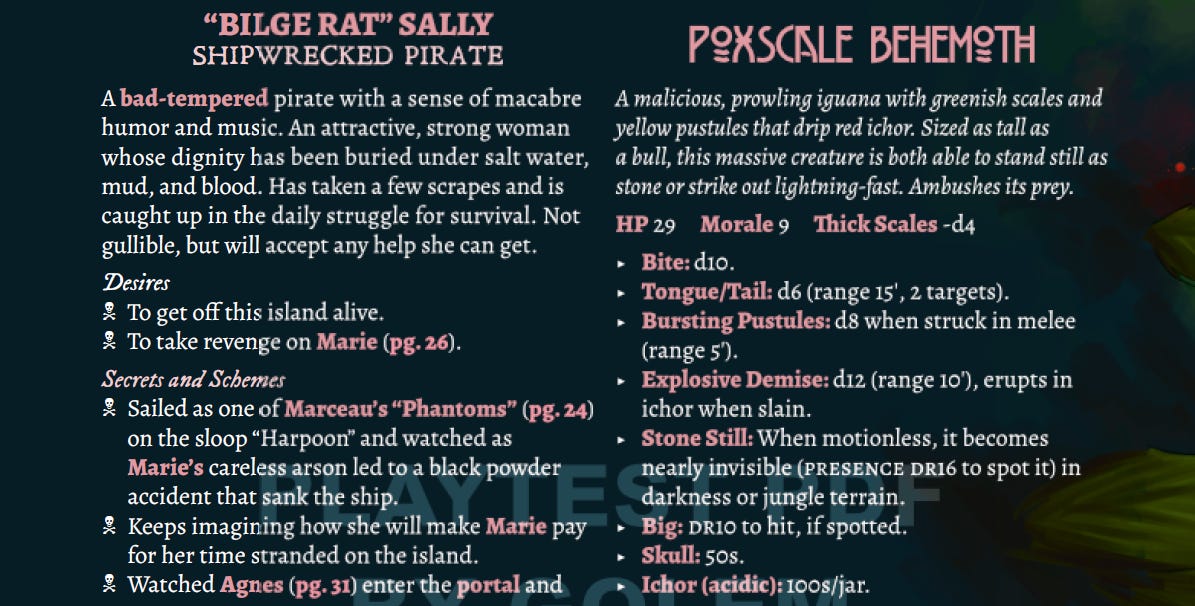
Pirate Borg has already taken a slightly different path, leaning into clarity while still feeling visually bold. Its more recent books even remind me of Old-School Essentials in their readability and structured presentation. We decided to follow that direction. Our motto—‘art-heavy but not art-punk’—means we’ve invested heavily in visuals (over 40 pieces of original art in Ravaged by Storms), but we’ve paired them with clean, functional layout that’s easy to parse mid-session.
Working with award-winning editor John Baltisberger - how did that collaboration shape the final product? What did he push you to reconsider or refine?
John is a highly experienced, educated editor who is a pleasure to work with. We are truly thrilled that he helped us edit our adventures. He was responsible for copyediting and proofreading Ravaged by Storms, and will thankfully be doing the same for the other upcoming components of our campaign, such as the Enhanced Edition of our adventure The Scarlet Coral Citadel.
John’s work has improved the clarity of my writing and repeatedly introduced interesting phrases that express even more accurately what we wanted to convey. This is invaluable, especially when your native language is not the one in which you publish. And John inspires me with the many interesting projects he works on for himself and for others.
What specific techniques or design elements are you borrowing from systems like Mothership that Borg games typically overlook?
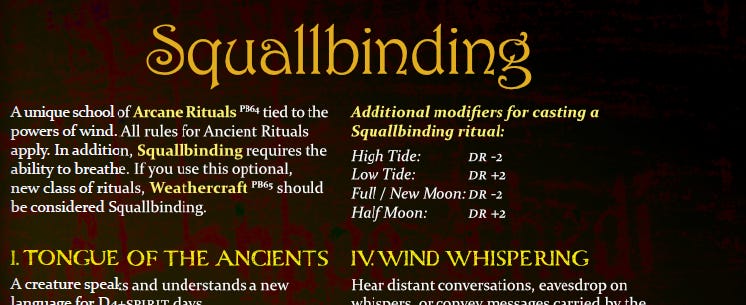
Tough question. Mothership, in particular, has taught the RPG world a lot about how to make adventures usable at the table. Many Borg hacks stop at mood and aesthetics—which is great for inspiration—but they often leave the GM with the heavy lifting of turning vibes into playable material. We wanted to build on Pirate Borg by incorporating some of the concrete design techniques that make games like Mothership and OSE so effective.
Information design & clarity: Important details are presented right where the GM needs them—through concise keys, bolded triggers, and sidebars—so the game flows smoothly without page-flipping. Like Mothership’s panic or OSE’s encounter tables, we’ve built in generators and fun tables, plus faction procedures, to keep the world dynamic and improvisation easy.
While Ravaged by Storms still feels brutal and atmospheric like a Borg game should, we’ve also embraced Mothership’s philosophy of varied challenges. Not every obstacle is a fight—players face storms, mysteries, moving factions, and puzzles that reward creative problem-solving and player skill.
Many Borg adventures tend toward linear hack-and-slash. Do you think this is a limitation of the system itself, or more about designer habits and player expectations?
I’d say it’s more about designer habits and player expectations than the system itself. The Borg chassis is fast and brutal, so it’s easy to default to hack-and-slash dungeon crawls. But look at Mark of the Odd games like Cairn or Eco Mofos, or at Mothership: they use similarly lean mechanics, yet combat can be rare, often avoidable.
What matters is the design philosophy. If you build scenarios that emphasize exploration, player choices, and creative problem-solving, the rules absolutely support that. However, Borg systems are ideal for cinematic, action-packed scenes full of swashbuckling pirates swinging from ship to ship with grappling hooks or battling sea monsters. That’s part of the fun!
The Adventure Itself
The Coatl sounds like a fascinating mechanical centerpiece - this entity that moves around and literally changes the map. How did this concept emerge, and what does it feel like for players when the geography itself becomes unreliable?
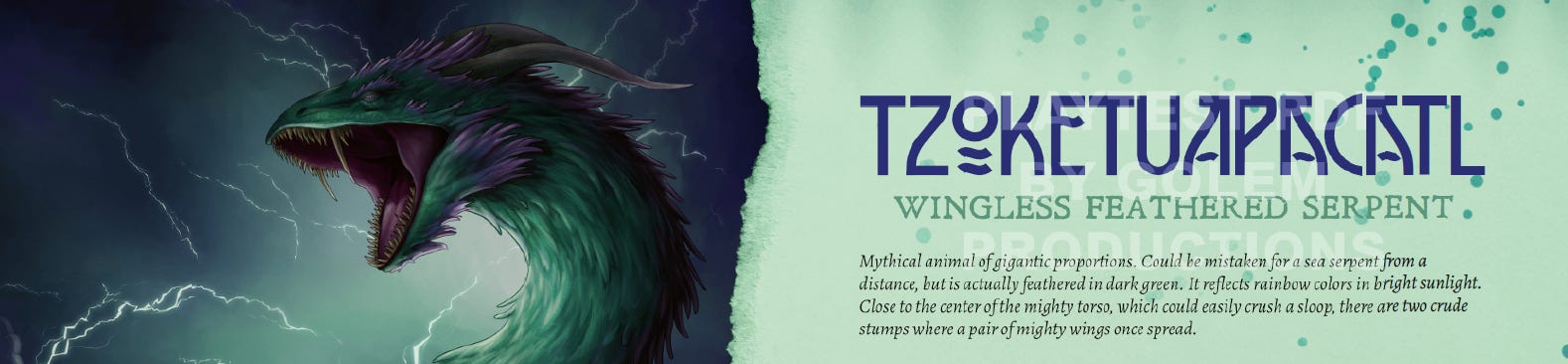
What actually happened was that I saw a feathered snake in a thunderstorm on the cover of another adventure, but it never actually appears physically in that module. I wondered how epic it would be to encounter such a creature and how an adventure centered around this encounter might look.

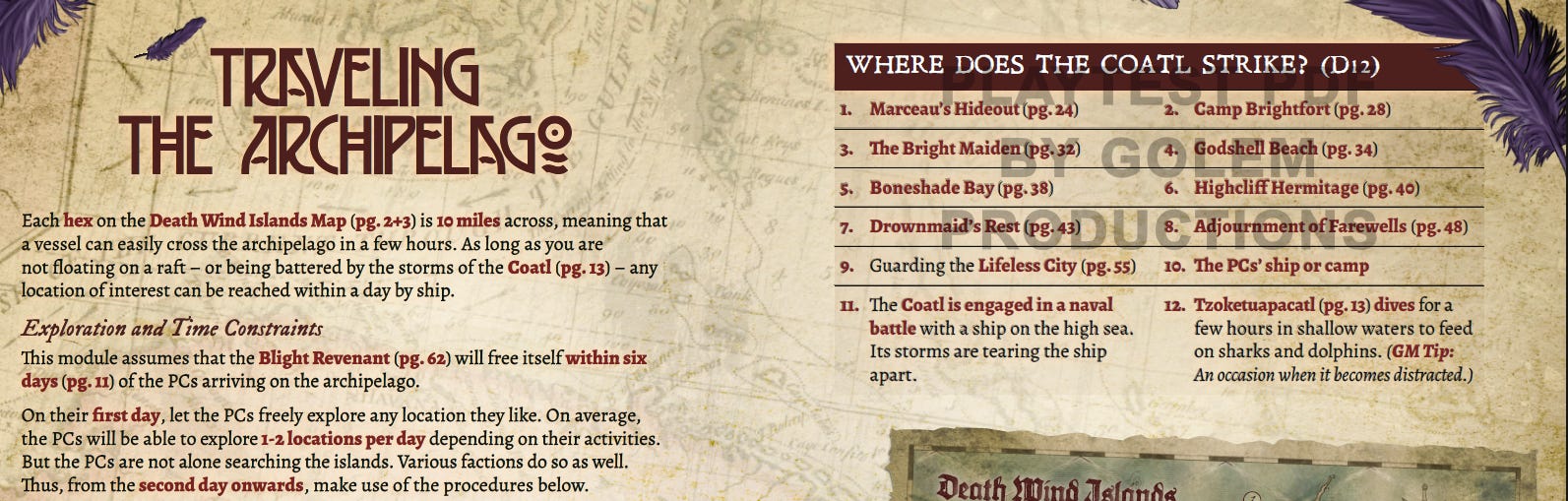
From the beginning, the Coatl struck me as a creature that would move dynamically and unpredictably. In the adventure, this is supported by the fact that someone has stolen from the snake and it is searching for the relic in question. Mechanically, this affects travel procedures. Every day, the GM rolls to determine in which location of the archipelago on which Ravaged by Storms is set the Coatl is searching or whether it is doing something else. It can also appear as a random encounter.
The effects are serious: each of the locations described in the book comes with a sidebar called “After the Coatl attacked” describing how the place has changed, if the PCs were not present at the time of the Coatl searching it. This can cause NPCs to die, places to change, or even new encounters to arise. In addition, the Coatl engulfs itself in storms, which can also affect neighboring locations. And if the PCs encounter it, the adventure offers more than “just” a boss monster.
Your Storm Generator is mentioned as a key innovation. Without spoiling too much, can you give us a taste of how dynamic weather becomes more than just atmospheric flavor in your system?
Yes, there has been no tool for this in the Pirate Borg materials so far. However, especially in campaigns that take place largely on the high seas, I think weather can be more than just a backdrop.
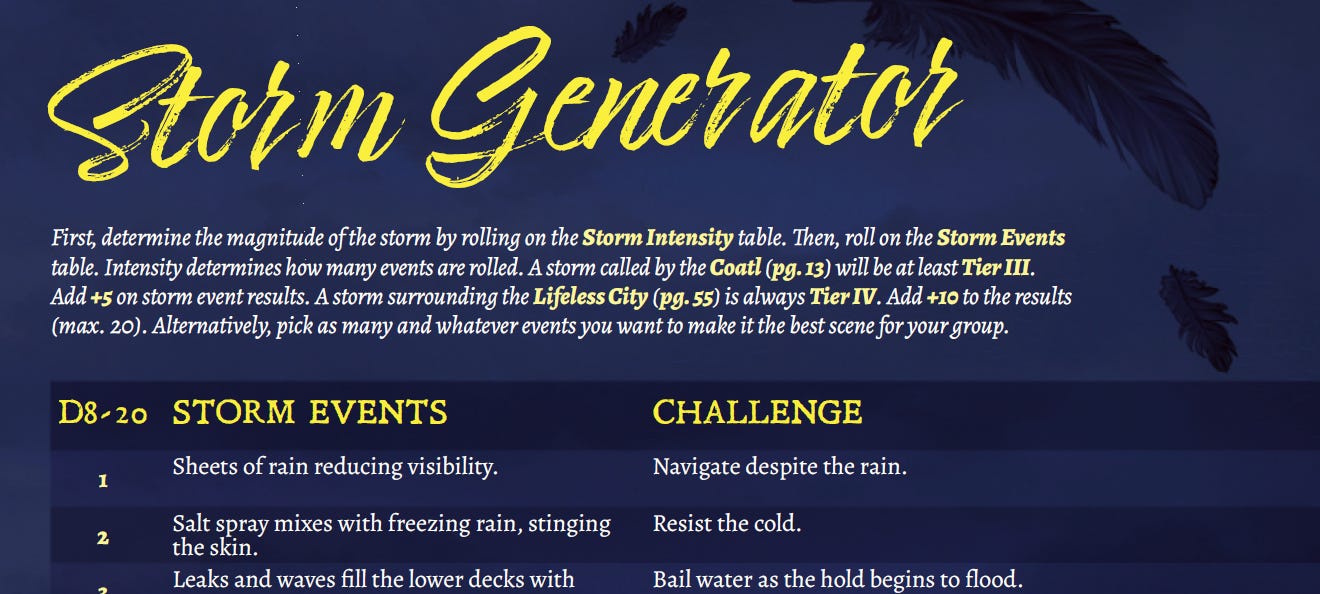
To build tension at the table, we give GMs narrative tools on how to describe storms. We have worked out a large number of events that can occur on board during a storm, with descriptions, possible attribute checks, and consequences if things go wrong. However, our advice is not to deal with a storm quickly with a dice roll, but to turn it into a narrative and energy-sapping challenge where clever ideas and good narratives will be rewarded.
The Storm Generator helps to create a series of such events, ranging in intensity from annoying little squalls to apocalyptic hurricanes. It deals with the specific, mystical tempests that will occur in this adventure, but can also be used in general for storms at sea in ongoing campaigns.
You mention that dynamic faction activities are a key part of your travel procedures. In a system known for high lethality, how do you design faction relationships that can develop meaningfully over multiple sessions when player characters might not survive that long? Do you have mechanisms to ensure faction storylines continue even with character turnover?
In addition to the Coatl, three factions are active in Ravaged by Storms, each with an interest in the ongoing events, but also in conflict with each other. As is typical for OSR, it is completely open as to who the PCs are facing. That depends on their respective campaigns. However, if a group is starting with new characters, a specific faction is probably the most obvious choice, but the PCs can also stand entirely on their own.
In this scenario, players can presumably have a significant influence on how the factions relate to each other and to the Coatl, and can also bring about changes. These remain in place even if a PC dies. Playtesters have sometimes pitted the factions against each other and sometimes turned them all against themselves.
In general, though, the lethality of Pirate Borg is somewhat overestimated, as Luke Stratton himself has often said—and I can confirm this from my own private gaming sessions. After just one advancement and perhaps with a little luck in character creation, the game is not that deadly, even compared to other Borg games. In the event of a character death, the simplest solution would be to promote an NPC from the crew or one of the active factions to a PC. Undeath is also always a valid option in Pirate Borg.
This Kickstarter includes two other adventures alongside Ravaged by Storms. How do these three adventures work together? Are they connected narratively or just thematically?
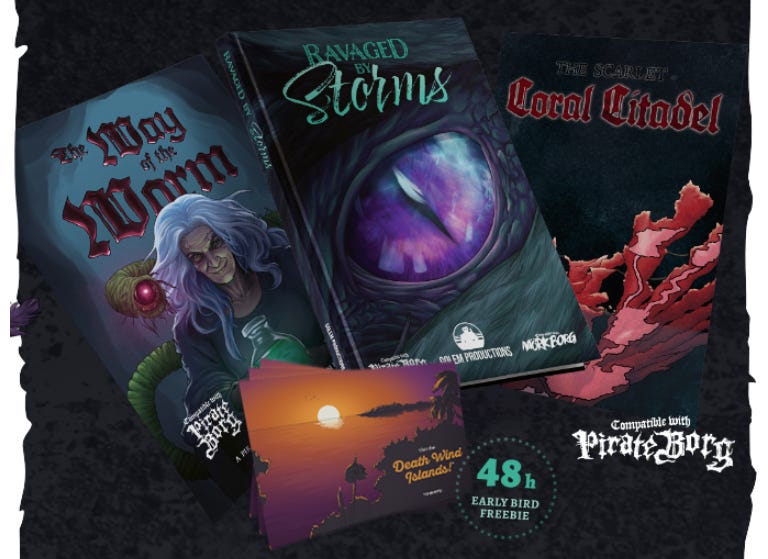
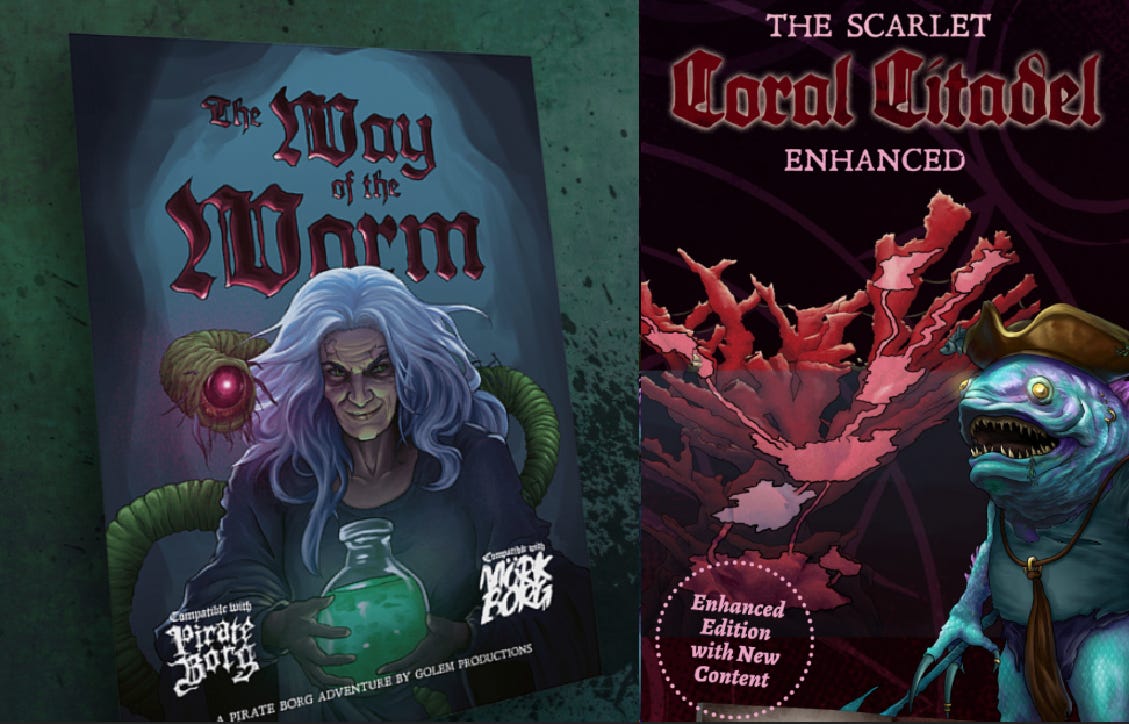
Yes, The Way of the Worm was our debut which won “Best Adventure” at Limithron’s CABIN FEVER jam and will be printed in their book as well. And then there’s The Scarlet Coral Citadel, which will enhance with new illustrations, some restructuring for better clarity, and new content.
Basically, all three adventures are thematically independent and can be played on their own, although the aforementioned two are rather short zines for 1-2 sessions. However, we have dedicated a full page of Ravaged by Storms for optional tie-ins with other adventures. We suggest some possible connections between our material but also most available first party adventures. This is intended to assist GMs who find it challenging to connect different adventures into a larger story.
Meta-Questions & Reflection
If someone has only ever experienced Borg games as deadly convention one-shots, what's your elevator pitch for why they should try a multi-session campaign?
One-shots show you how fun Pirate Borg can be. A campaign lets you discover just how deep it can go. Building a crew, equipping a ship, earning a place among the legends of unforgettable pirates: you don't do that in one evening. If episode 1 of a series got you hyped, just watch the whole season!
You mention complex sandboxes and deep immersion as goals. These seem almost antithetical to the fast, brutal Borg aesthetic. How do you create depth without slowing down the pace?
I believe that the Pirate Borg rule system—and by that I mean not only the core rules but also the material found in more recent publications—makes it almost difficult to be slow: Character creation takes just a few minutes. OSR only requires dice rolls when something is really at stake, and in this game you almost always only roll one die. Even the hexcrawling in the new starter set Trapped in the Tropics is super quick and easy.
Above that, we don’t achieve depth through extensive rule crunch, but through an immersive world and stories that captivate the player. The cinematic style of the Borg games is not at all disturbing depth. On the contrary, it helps to play out even larger scenes reasonably quickly and satisfactorily. But if you're really playing a longer campaign, maybe even over several months, then you probably can't spend every half hour swashbuckling across rooftops like Captain Jack Sparrow. Long-term storytelling naturally also involves quieter scenes and calmer moments, which must then be balanced with action.
Looking at the crowdfunding landscape for indie RPGs, what do you think creators need to understand about building an audience before launching?
That’s a really difficult question when you’re crowdfunding a project for the first time! By the way, it's going well and we've already unlocked 12 stretch goals with almost 850% funding.
I think above all, you have to take your time, especially with the oversupply of crowdfunding projects. We published smaller things a year in advance, have been active on social media ever since, started our own blog six months ago, began promoting the project four months ago, etc. I think you have to actively remind people of yourself, be able to show some results, and be present. But this question would be better answered by someone who has already successfully financed and fulfilled several Kickstarter projects.
If Ravaged by Storms succeeds in proving that Borg campaigns are viable, what's next?
Wow, that's going to keep us busy for a while. And we're proud and grateful to say that we've already unlocked a few smaller Pirate Borg digital projects for the time after that via stretch goals. And I really mean after that: in order not to jeopardize the timeline for the main products, we won't really start working on the stand-alone additional goals until the former are at the printer.
So yes, it started with Pirate Borg, and we're staying loyal to that. In addition, we've already been invited here and there to contribute smaller pieces—such as a stretch goal pamphlet adventure—to other projects, including from other RPGs. I love that, as I love the DIY spirit and collaborative mindset I’ve mostly found with other creators.
However, we have other ideas bubbling away. We're still working out which ones we want to tackle first, but sooner or later we'll definitely want to work on our own full-fledged game. An Odd one, I dare say …